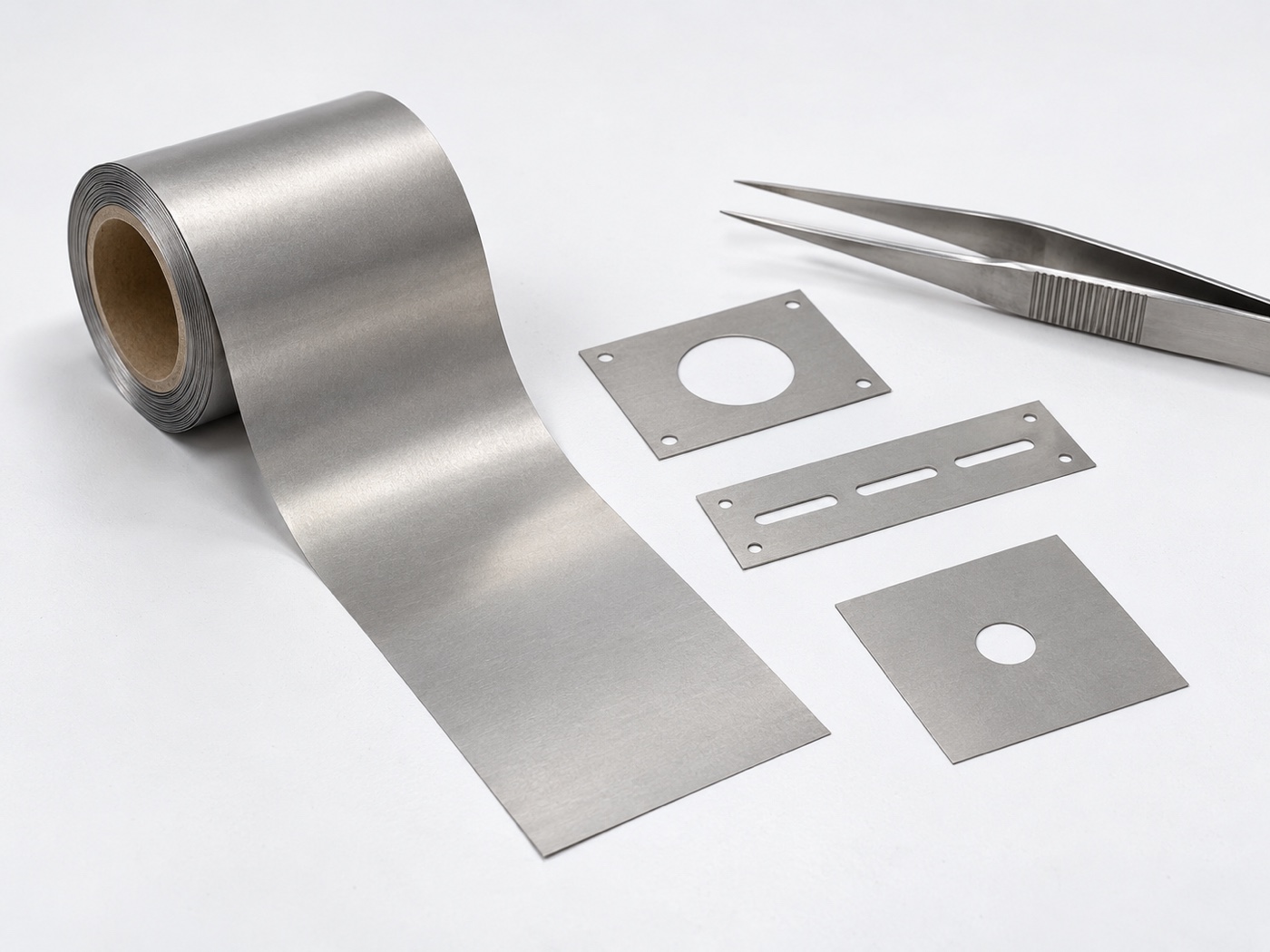
Grade 1 and Grade 2 titanium foil can look identical on a purchasing list, yet the choice affects forming, strength, handling and the evidence a supplier must provide. A reliable RFQ connects the exact commercially pure titanium grade to thickness, condition, surface, precision-cut geometry, inspection and the final service environment.
Quick answer
Grade 1 and Grade 2 are both commercially pure titanium grades, but they should not be treated as interchangeable names for the same foil. Grade 1 is generally selected when higher ductility and formability are important. Grade 2 provides a higher-strength commercially pure option and is a common starting point for general industrial parts. The correct choice still depends on the component function, forming route, corrosion environment, thickness, surface, certificate requirements and finished-part inspection.
For a useful quotation, specify the exact grade and UNS number, the governing material standard, nominal thickness, condition, surface, width or drawing, quantity and required records. Finalfoil can review titanium foil supply together with precision laser cutting, but feasibility and acceptance values are confirmed from the current drawing and material rather than a universal minimum feature or tolerance claim.
Grade 1 and Grade 2 at a glance
| Decision point | Grade 1 titanium | Grade 2 titanium |
|---|---|---|
| Common designation | Commercially pure titanium, UNS R50250 | Commercially pure titanium, UNS R50400 |
| General buyer priority | Formability and ductility | Higher strength while retaining useful formability |
| Typical project question | Will the foil be deeply formed, folded or conformed? | Does the part need more load capacity or shape retention? |
| RFQ risk | Assuming softer behavior without stating condition and thickness | Using “commercially pure titanium” without naming Grade 2 |
| Supplier evidence | Grade-linked chemistry and mechanical records for the supplied lot | Grade-linked chemistry and mechanical records for the supplied lot |
ASTM B265-25 identifies Grade 1 as UNS R50250 and Grade 2 as UNS R50400 within its scope for annealed titanium and titanium-alloy strip, sheet and plate. The grade designation is only one part of the order. Product form, thickness, condition, dimensions and supplementary requirements still need to be aligned with the purchase order.
Start with the part function, not the grade name
A buyer should first describe what the foil component must do. A formed sensor diaphragm, flat corrosion-resistant shim, lightweight aperture plate and weld tab can place different demands on the same nominal titanium grade. Grade 1 may be attractive when the part must conform or undergo more forming. Grade 2 may be preferred when the design needs a stronger commercially pure titanium option. Neither statement replaces prototype testing or the responsible engineer’s design calculation.
List the loads, temperature, media exposure, joining route, expected flexing and cleaning process. Identify whether the foil remains flat, receives bends, becomes a shallow formed shape or is clamped around its perimeter. If the application is safety-critical, regulated or used in a pressure boundary, the applicable design and product standards must be selected by the responsible engineering organization.
Commercially pure does not mean one universal material
Commercially pure titanium grades are differentiated by controlled chemistry and resulting mechanical behavior. Manufacturer data for commercially pure grades describe increasing strength levels across the grade family as interstitial content changes. That is why an RFQ should not say only “pure titanium foil.” It should name the grade, UNS number and required standard.
Do not substitute Grade 1, Grade 2, Grade 5 or Grade 23 based on the word titanium. Grade 5 and Grade 23 are titanium alloys with a different composition and performance profile, while Grade 1 and Grade 2 are unalloyed grades in ASTM B265. If an equivalent material is acceptable, define the properties, documents and approval process instead of leaving substitution open-ended.
Thickness and condition can change the sourcing decision
Very thin titanium foil is sensitive to coil set, local dents, creases and handling marks. Reducing thickness changes stiffness, forming response, fixturing and the way a cut part is released from a carrier. A grade that works in a thicker sheet does not automatically behave the same way as ultra-thin foil in a narrow bridge or large unsupported window.
State nominal thickness and the agreed measurement method. Clarify whether the requirement applies to raw foil, coated material or a finished part. If the drawing includes bends or formed features, specify material condition and rolling direction. When a supplier offers only a particular condition at the requested gauge, the design team should review that actual material before locking the process.
Use the titanium foil material page to begin the material discussion, then send the complete drawing and acceptance plan for availability review.
Surface requirements must describe the downstream operation
Titanium foil may be ordered for welding, bonding, coating, sealing, electrical isolation, fluid contact or a visible surface. Each use can place a different limit on scratches, embedded particles, oxide, residue and handling marks. Words such as clean, bright or medical grade are not measurable acceptance criteria.
- Name the critical face and any nonfunctional handling zone.
- Define whether protective film, interleaving or individual packaging is allowed.
- List prohibited oils, adhesives or cleaning agents.
- State whether the buyer will perform final cleaning or passivation.
- Agree on visual inspection lighting, magnification and reference samples.
- Separate cosmetic appearance from a functional surface defect.
For joining or coating work, provide representative downstream process information. A foil supplier can control the delivered surface to an agreed specification, but cannot validate every later bonding, welding or coating process from a generic grade name.
Choose the cutting route around the geometry and acceptance method
Straight strips, simple blanks and repeated production profiles may be suited to slitting, shearing, stamping or conventional precision laser cutting. Dense micro holes, narrow slots, heat-sensitive details or frequent prototype revisions may justify an ultrashort-pulse review. The route should be chosen after considering thickness, feature density, quantity, edge requirement, cleanliness and inspection time.
Femtosecond laser micromachining can reduce the thermal interaction zone for suitable titanium foil features, but it does not make every edge automatically perfect. Oxide, discoloration, recast, taper, debris and local distortion still need to be evaluated for the actual geometry. Precision laser cutting may be the more practical route for larger features or quantities where ultrashort pulses do not add functional value.
The drawing should mark functional edges, burr or edge-direction requirements, temporary carrier tabs and inspection datums. If loose parts would tangle or distort, ask whether a retained frame or indexed strip can support cutting, cleaning and shipment.
Inspect the finished part separately from the material certificate
A material certificate supports the identity and tested properties of the supplied lot. It does not prove that a laser-cut hole, slot, outline or formed part meets the drawing. Finished-part inspection may include profile, hole diameter, slot width, pitch, edge condition, thickness, flatness and visible surface condition.
Optical measurement on thin reflective foil depends on lighting, focus, threshold, part support and datum selection. Critical dimensions need an agreed method, not only a tolerance printed on the drawing. If a feature will be measured in a fixture, share the fixture logic during quotation. If flatness matters, define sample support, free-state or restrained condition and the usable zone.
Material standards and certificate requirements
ASTM B265-25 is the current ASTM specification page for titanium and titanium-alloy strip, sheet and plate, and its scope includes annealed Grade 1 and Grade 2. ISO 7209:2023 specifies technical delivery conditions for titanium and titanium-alloy plate, sheet and strip and has an amendment published in 2024. The buyer should identify which standard, edition and supplementary requirements control the order.
For Grade 1 and Grade 2 behavior, the ATI commercially pure titanium technical data sheet is a useful manufacturer reference, but typical data is not a substitute for the certificate and acceptance limits on the purchased lot.
- Request an MTC or CoA when batch-linked chemistry and mechanical data are required.
- Request an SDS for safe handling information, not as proof of finished-part dimensions.
- List RoHS, REACH or other declarations only when the project requires them.
- Define heat or lot traceability from incoming foil through cut-part packaging.
- Confirm whether inspection results must appear on a dimensional report.
Review Finalfoil’s technical resources and download center, then name every mandatory document in the RFQ so availability can be confirmed before an order is placed.
Medical, aerospace and corrosion claims need boundaries
A titanium grade can appear in medical, aerospace, chemical-processing or research contexts, but buying that grade does not automatically qualify a finished component for any regulated use. Implant, aircraft, pressure, cleanroom and fluid-contact applications may require additional standards, approved sources, process validation, testing and traceability.
Describe the actual environment rather than relying on a broad industry label. For corrosion service, provide media, concentration, temperature, exposure time, crevice conditions and cleaning cycle to the responsible materials engineer. For medical or laboratory hardware, identify whether the foil contacts tissue, fluid, reagents or only an external fixture. Finalfoil can review material supply and dimensional processing; the device owner remains responsible for application qualification.
Supplier comparison checklist
- Can the supplier distinguish Grade 1, Grade 2 and titanium alloys by exact designation?
- Will the quotation state thickness, condition, surface, width and product form?
- Can material availability be reviewed before the drawing is frozen?
- Does the supplier connect cutting method to geometry, quantity and inspection?
- Are material certification and finished-part inspection kept separate?
- Can lot traceability remain with cut parts and packages?
- Will the supplier avoid unsupported universal feature or tolerance claims?
- Can prototypes be shipped in a frame, strip or protective package when needed?
RFQ information to send
- Grade 1 / UNS R50250, Grade 2 / UNS R50400 or another exact grade
- Material standard and required edition
- Nominal thickness, width, sheet or coil format and condition
- Critical surface, rolling direction and forming requirements
- DXF or DWG geometry plus a dimensioned PDF
- Functional edges, datums, carrier tabs and inspection method
- Cleaning, packaging, labeling and traceability requirements
- Prototype quantity, expected production quantity and revision status
- MTC, CoA, SDS, compliance declaration and dimensional-report needs
Frequently asked questions
Is Grade 1 always better for very thin titanium foil?
No. Grade 1 can offer higher formability, while Grade 2 offers a higher-strength commercially pure option. The correct choice depends on the part, condition, thickness, forming and service requirements.
Can Grade 2 replace Grade 1 without a drawing change?
Do not assume automatic substitution. Material behavior, forming, springback, joining and validation can change. Any substitution should follow the buyer’s documented approval process.
Does ASTM B265 define every custom laser-cut tolerance?
No. A material product standard and a finished-part drawing serve different purposes. Custom geometry and inspection requirements must be agreed separately.
What is the smallest feature Finalfoil can cut in titanium foil?
There is no single value for every grade, thickness, geometry and acceptance method. Send the current drawing, material, quantity and inspection plan for a feasibility review.
Request an engineering review
Send the titanium grade, governing standard, thickness, condition, surface requirement, drawing, quantity, downstream process and inspection plan. Finalfoil will review foil availability and the appropriate precision laser route before quotation.